
Three time zones away, a seller once asked me to walk her mother’s house because her listing agent wouldn’t. The agent was licensed six hundred miles from the property. She’d signed with him because he sold her last house, and he meant well, but he’d never set foot inside the one he was marketing. If you’re trying to find a realtor for a home in a state you’re leaving (or one you’re heading toward), that gap between loyalty and license is the whole problem.
Moving cross-country stacks two transactions on top of each other. Selling here. Buying there. Both deserve real representation, and the market isn’t making it easy right now.
Can a Local Realtor Help You Buy or Sell in Another State?
Your agent sold your last two houses, knows your kids’ names, and offers to handle the whole relocation. It sounds clean. Then the paperwork hits a wall, because real estate licenses are issued state by state, not nationally.
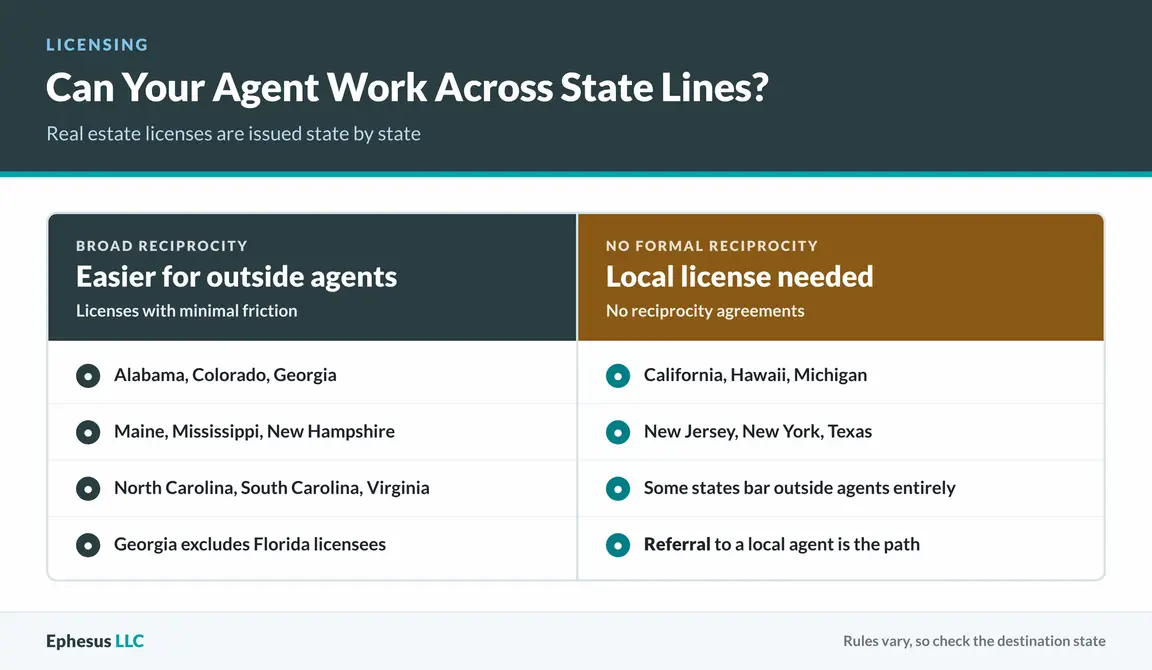
A few states hand out licenses to out-of-state agents with minimal friction. Alabama, Colorado, Georgia, Maine, Mississippi, New Hampshire, North Carolina, South Carolina, and Virginia offer broad reciprocity, though Georgia carves out an exception for Florida licensees. Other states won’t budge at all. California, Hawaii, Michigan, New Jersey, New York, and Texas don’t run formal reciprocity agreements at all, and a handful of states block out-of-state agents from touching a transaction on their soil under any arrangement.
Portability is the second layer, and it trips people up more than licensing does. Some states let your agent co-broker a transaction alongside a locally licensed partner, while others restrict them to working remotely, which means no showings, no walkthroughs, no sitting at your kitchen table. States that permit nothing at all include Kentucky, Missouri, Nebraska, New Jersey, New Mexico, Pennsylvania, and Utah.
So can your agent help? Partly. They can refer you, advise you, and read a contract with you over the phone. What they can’t do in most of the country is represent you on the ground.
I’d argue the referral path is better anyway, even where the law allows a workaround. An agent working outside their home market is guessing at school boundaries, flood history, and which inspector the local brokerages trust. That guesswork gets expensive. The smarter move is to find a realtor whose business lives in the market where your property sits, then let your existing agent make the handoff.
How Do You Find a Realtor in Another State?
Which brings up the obvious follow-up: where do you start looking when you don’t know a soul in the destination city? To find a realtor in a city you’ve never lived in, your current agent is the first call, and not for sentimental reasons. Agents carry referral networks built from conferences, brokerage relationships, and designations earned over years. Ask yours directly who they’d send their own sister to.
Beyond that, the big platforms do real work. Realtor.com, Zillow, and Redfin all list agents by market with closed transaction counts attached, so you can see who’s actually closing sales nearby. Each one gives you names. None of them gives you judgment.
Here’s where I’d push back on common advice: don’t pick from the top of a search page. Those placements are frequently paid. Pull three or four names, then cross-check each one against the state licensing board and the Better Business Bureau before any phone call happens.
Local knowledge still beats national branding. A broker who’s written offers in one zip code for twelve years knows which HOA has pending litigation. A national platform doesn’t surface that.
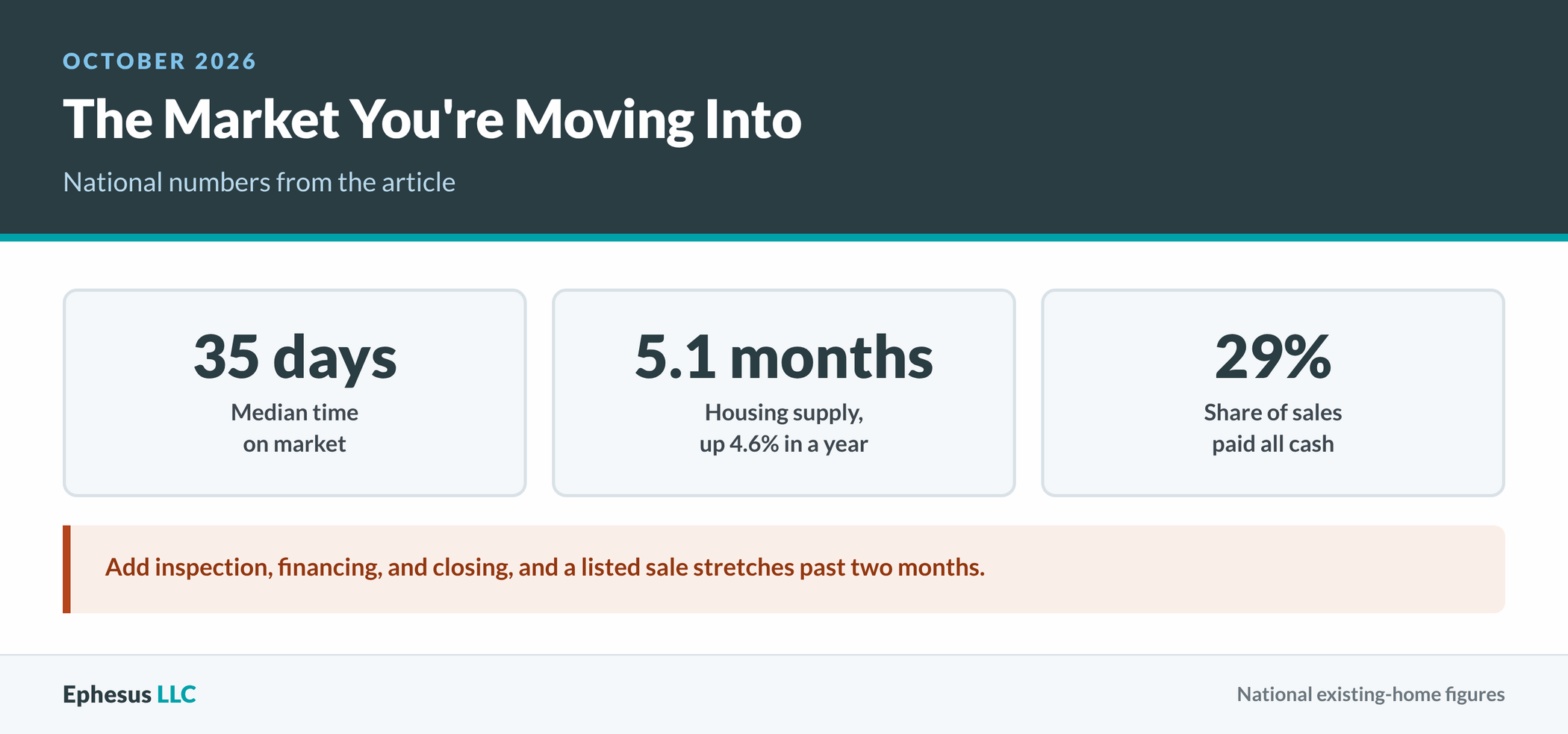
For the house you’re leaving behind, the calculation shifts. You might not need to find a realtor at all if the property needs work you can’t manage from another state. NAR reported a median time on market of 35 days in October 2026, up from 34 days a year earlier. Add inspection, financing, and closing on top of that, and a listed sale stretches past two months easily. Companies like Ephesus LLC buy directly, which removes the long-distance repair coordination entirely.
Email is your friend during the search. Message five agents the same three questions and watch who replies within a day.
How Does a Nationwide Realtor Referral Service Work?
Referral services can help you find a realtor fast, but they aren’t charities. Know who’s paying whom before you sign anything.
It’s a pretty simple setup. One licensed agent or brokerage introduces you to another, and when your transaction closes, the receiving brokerage pays the referring one a cut. The most common arrangement is 25% of the gross commission earned by the receiving brokerage on the referred side, though the range typically runs from 20% to 35%. Corporate relocation networks push higher, since 35 to 40% often applies when a relocation company has done the vetting work upfront.
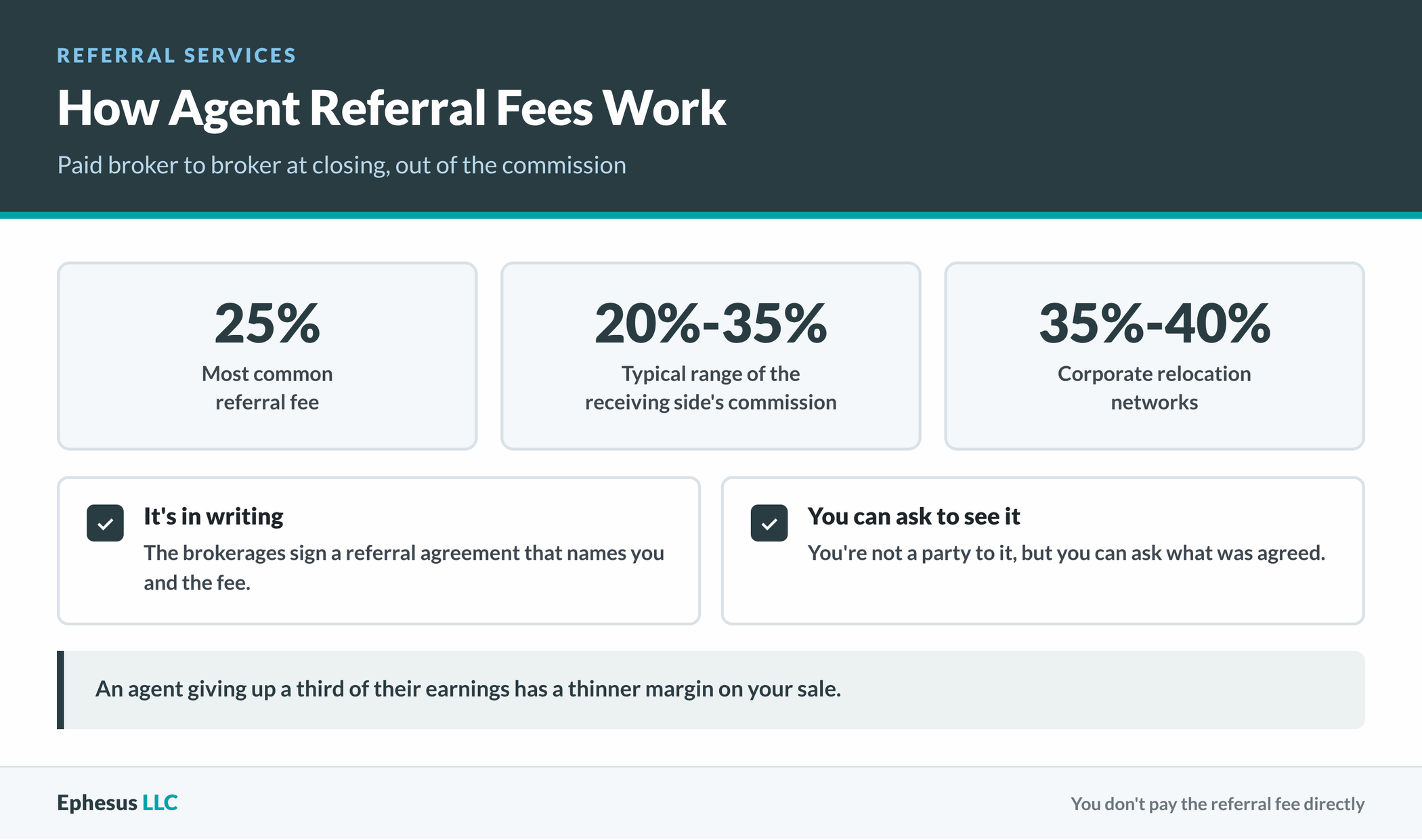
Every piece of that lives in a written agreement between brokerages. A proper referral contract names the client, states the fee percentage, specifies which transactions it covers, and sets how long it stays active. You’re not a party to it, but you can ask to see it.
Early last year a family in Lowell, Massachusetts called me three months behind on their mortgage with an auction date already on the calendar. Their relocation referral had matched them with a perfectly competent listing agent, but the timeline didn’t fit their situation at all. So we closed before the sale date and they kept the camper in the garage they’d been planning to sell for legal fees.
Does the referral fee come out of your pocket? No. It’s carved from the commission, not added to your closing costs. That said, an agent giving up a third of their earnings on your sale has a thinner margin to work with. I’d rather you know that going in.
What Should You Look for in an Out-of-state Realtor?
For years I told sellers to prioritize the Realtor designation over everything else, and I was oversimplifying.
Buyers care about the title, just not in the way most think. NAR counted 1,438,569 members as of June 2026, and those members commit to the association’s Code of Ethics, which gives you a formal complaint path a state license alone doesn’t. But an individual agent’s track record, local expertise, and responsiveness carry more weight than the title itself.
Transaction volume in your specific price band tells you more. An estate agent who closes forty sales a year at the luxury tier may be wrong for a modest investment property. Ask for their last ten closings with addresses redacted. Then look at the pricing accuracy: how close were list and sale?
Watch for dual agency language in any listing agreement they hand you. Some states permit it, some ban it outright, and the rules differ enough that your attorney should read the contract before you sign from another time zone.
Designations worth noticing include the Certified Residential Specialist credential, which requires documented production rather than a weekend class. Military relocation and relocation-specific certifications signal the agent has handled compressed timelines before.
Communication style is the quiet dealbreaker. You’re going to be managing this transaction by email and text across a time difference, so an agent who takes four days to respond will cost you a sale. Test that during the interview, not after.
One pattern I keep seeing: sellers hire the agent with the best marketing deck and the worst phone habits. Pretty brochures don’t negotiate repairs.
What Questions Should You Ask Before Hiring a Realtor in Another State?
A seller reached me last spring after her out-of-state listing had sat for ninety days with three price cuts. She’d never asked her agent a single question about how the property would be marketed; she’d just signed the agreement the day they met.
Start with representation itself. Who, exactly, will show the house, and will it be the agent or an assistant you’ve never spoken to? Long-distance sellers end up with junior staff running their listing more often than anyone admits.
Then get specific on data. Ask what comparable properties sold for in the last ninety days, not the last year, because mortgage rates climbing back above 7% since mid-September 2026 pushed buyers to the sidelines and older comps lie. Ask how they’d price against current inventory, and push for specifics rather than a vague range. Housing supply reached 5.1 months in October 2026, up 4.6% from a year before, so your competition is thicker than it was.
Buyers should ask financing questions too. How do they vet a buyer’s lender, and will they call the loan officer directly before recommending you accept? Weak preapprovals kill long-distance sales at week six, when you’ve already given notice at work.
Other things worth asking: what’s their plan when an inspection comes back rough and you’re two thousand miles away? Who holds the keys? Which attorney or title company do they work with, and does state law require an attorney at closing?
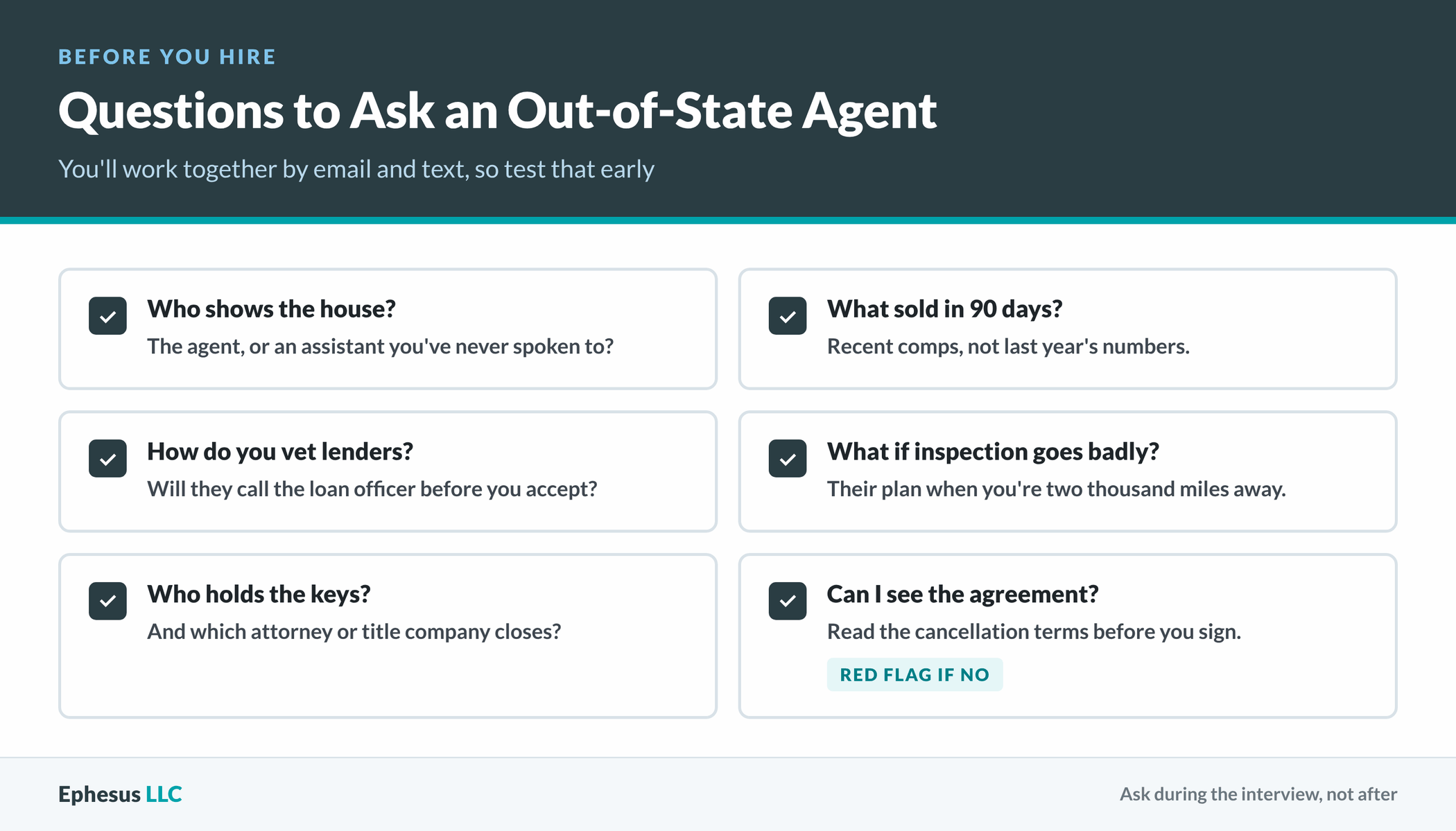
Request the listing agreement in advance and read the cancellation terms. If an agent resists sending the contract before the interview, that’s your answer.
Is There a Fee to Find a Realtor in Another State?
“Sounds like another middleman taking a cut.” I hear that, and the skepticism is reasonable, but it doesn’t match how the money moves here.
Searching costs you nothing. Realtor.com, Zillow, and Redfin don’t charge you anything to find a realtor or request a match. The platforms make their money from agents, so it’s worth understanding that an agent paying for leads has already priced that into their business.
Referral arrangements work the same way from your side: broker to broker, paid at closing, out of commission dollars. Nobody sends you an invoice for an introduction.
Your real cost shows up in commission, which is negotiable and has been more so since the 2024 industry settlement changed how buyer compensation gets disclosed. Full-service brokerage commissions have historically run 5 to 6% of sale price nationally, and the exact number varies by state and region. On a sale near the national median existing-home price of $416,700 in October 2026, that spread represents real money.
What about the house you’re leaving? Selling direct cuts commission out, though the offer reflects condition and the buyer’s carrying costs. Ephesus LLC buys houses like that without charging fees, which some relocating owners prefer over managing repairs remotely.
Would you pay a few thousand dollars to avoid flying back twice for contractor meetings? Some people would. Others want top dollar and will take the trips. Neither answer is wrong; the math just differs per household.
How Do You Find a Realtor Near a Military Base or Specific City?
Pick the wrong agent near a base and you’ll miss a PCS window, which can mean paying a mortgage and off-post housing simultaneously for months.
Base-adjacent markets run on their own clock. Orders drop, families move in sixty days, and VA financing carries requirements a general-practice agent may fumble. When you find a realtor near an installation, ask how many VA loans they’ve closed and whether they’ve worked the base housing office. Agents carrying the Military Relocation Professional certification have trained specifically on these timelines.
Narrowing your search pays off when you need to find a realtor in one specific city. Instead of a statewide hunt, search by neighborhood and filter for agents with recent closings within a few miles of your target. Subreddits and local Facebook groups generate names, but verify every one against the state commission’s license lookup before you call. A name from a message thread is a lead, not a recommendation.
The market you’re entering matters, too. All-cash buyers made up 29% of October 2026 sales, so a financed offer competes against people who can close in two weeks. An agent who knows which sellers prioritize certainty over price is worth their fee.
An heir in Springfield, Massachusetts called me after two years of chasing rent checks on a duplex he never wanted. The tenant’s dogs had wrecked the back unit, he lived in a different state, and he’d spent a Saturday every month driving four hours each way to patch something. He didn’t want to find a realtor and wait out a listing; he wanted the property gone before another lease renewal.
That’s the fork in the road. If the property is solid and you’ve got time, find a realtor who knows the block. If it’s a rental you inherited and resent, direct sale is cleaner.
Frequently Asked Questions
Can You Work with a Realtor Who’s Licensed in a Different State?
Only in limited ways. An agent licensed elsewhere can refer you, consult informally, and coordinate the handoff, but representing you in a transaction generally requires a license in the state where the property sits. Some states allow co-brokering with a locally licensed partner; others prohibit out-of-state participation completely. Your destination state’s real estate commission website will spell out which category applies.
What Is the 80/20 Rule for Realtors?
It’s shorthand for the observation that a small slice of agents closes most of the sales in any given market. Roughly a fifth of the agent population handles the bulk of transactions, while the rest close a handful a year or none at all. That’s exactly why you ask for closing counts when you find a realtor from a distance, since the title on a business card tells you nothing about volume.
Should You Find a Realtor Before or After You Move?
Before, by a wide margin. Interviewing agents while you still have flexibility in your schedule beats scrambling once you’ve arrived with a moving truck in the driveway. Starting early also gives you time to verify licenses, read agreements, and compare marketing plans without a deadline pressing on you. Most relocating sellers who struggle started the search about a month too late.
Do Both Agents Need to Know About the Referral Arrangement?
Yes, and the agreement gets signed between the two brokerages before you’re introduced, not after. You’re entitled to ask whether a referral arrangement exists and what percentage was agreed on. An agent who dodges that question is telling you something about how they’ll handle the rest of your transaction.
If you’re weighing a listing against a direct sale on a property you’re leaving behind, I’m happy to talk it through with you and lay out what each path would realistically look like. You might decide to find a realtor and list it, and that’s a fine outcome. No pressure, no obligation, just a straight conversation whenever you’re ready.
If the House You’re Leaving Is in Massachusetts
You may not need an agent on the ground at all. Boston-area homes sold for a median of $750,769 in the first half of 2026, per Redfin, with a median of 26 days on market. We buy houses from owners around Boston and across the state. We also buy from homeowners in Lowell. You won’t need to fly back for showings.
Talk With Us Before You Pack
Weighing a listing against a direct sale on the house you’re leaving? Reach out to Ephesus LLC and we’ll walk through both paths with you. There’s no pressure and no obligation. Fill out the form below to start the conversation.
Helpful Massachusetts Blog Articles