
A buyer’s lender can love your house, love your price, and still refuse to fund the loan over a missing stair railing.
You negotiate hard, you sign the purchase and sale, you start packing the attic in Arlington or Agawam. Then a report lands on an underwriter’s desk with three lines on it that stop everything. Appraisal required repairs don’t care about your moving truck deposit. I’ve bought houses all over Massachusetts for years, and I can tell you the repair list is where more sales die than almost anywhere else in the process.
What Are Appraisal Required Repairs in Massachusetts?
They aren’t a punishment, and they aren’t the appraiser’s personal taste.
Appraisal required repairs in Massachusetts are the specific conditions a lender insists you fix before a loan funds, and the appraiser writes the report “subject to” that work being done. When an appraiser spots conditions that need correction, the home isn’t automatically rejected; the report is issued subject to specific repairs, and the lender gets that list.
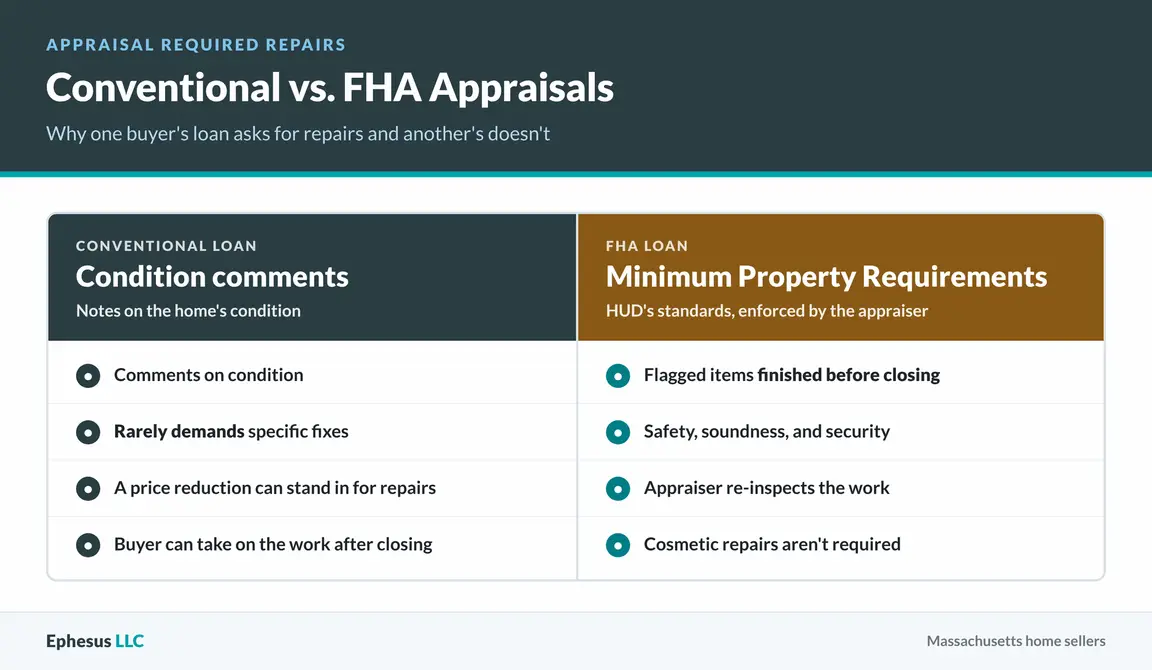
Conventional appraisals comment on condition but rarely demand specific fixes, while FHA appraisals enforce HUD’s standards, and flagged items have to be finished before closing. FHA calls its framework Minimum Property Requirements. People in the business shorten it to the three S’s: safety, soundness, and security.
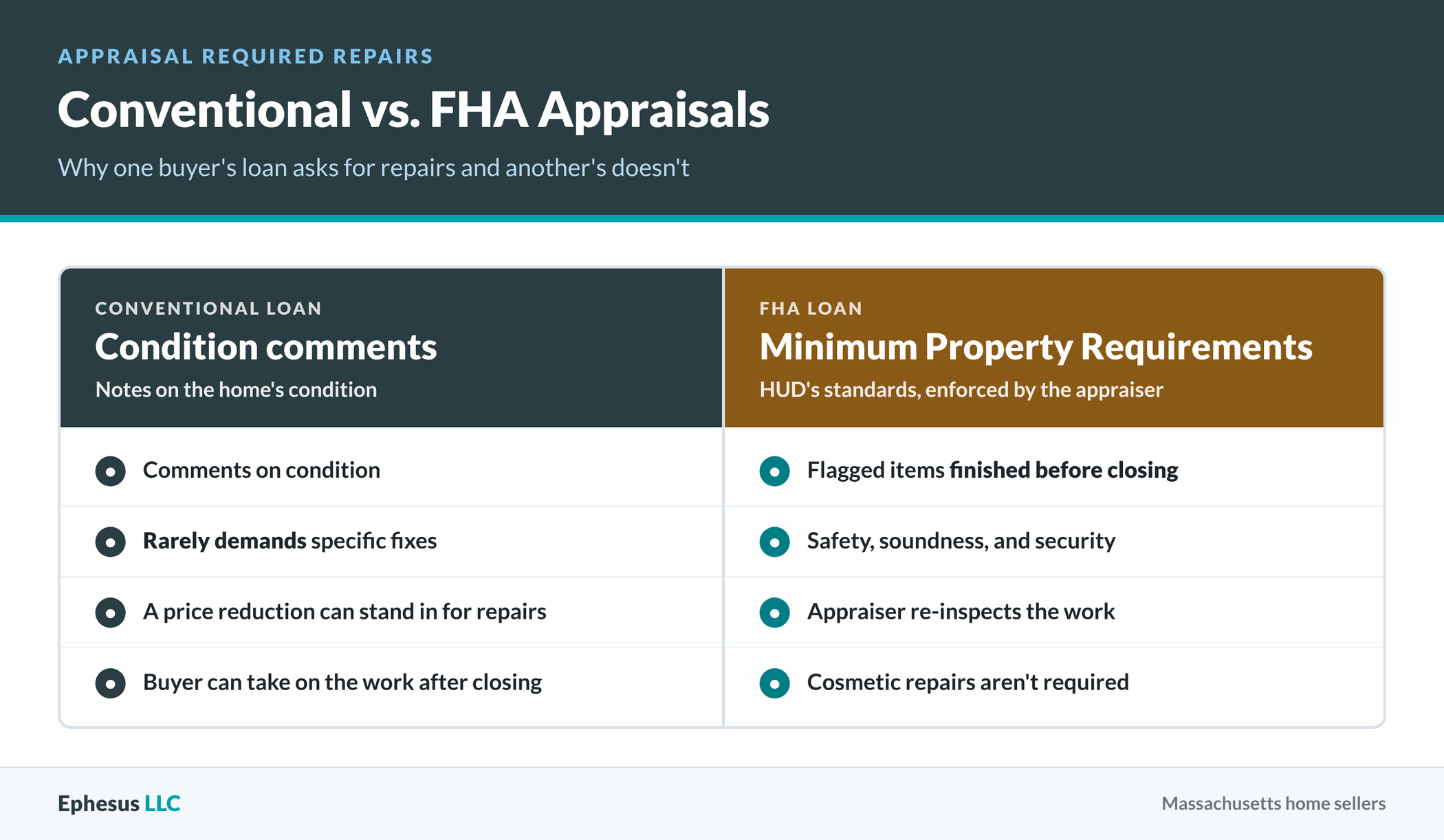
Cosmetic ugliness isn’t on the table. HUD’s own valuation protocol says cosmetic repairs aren’t required, though they do factor into the overall condition rating. The 1978 kitchen in Fall River can stay. A furnace that won’t light cannot.
One thing specific to Massachusetts sits next to all of this, separate from the lender’s list but just as capable of stopping a closing. Every home sale here needs a certificate of compliance for smoke and carbon monoxide detectors from the local fire department under M.G.L. Chapter 148, Section 26F. Sellers lump that in with appraisal required repairs because both land on the same pile of “fix it or don’t close.” Technically they’re different animals. Practically, you’re handling them in the same week.
What Causes an Appraiser to Require Repairs in Massachusetts?
Your house didn’t fail. Your buyer’s loan program did.
A real estate appraiser working an FHA file in Massachusetts is operating under rules written in Washington, not making judgment calls about whether your house is nice. Those standards exist to protect the lender and FHA as insurer from backing a loan on a property that isn’t structurally sound.
Age is the big driver in Massachusetts. Our housing stock is ancient compared to most of the country. Triple-deckers in Dorchester, mill-worker cottages in Lowell, farmhouses out past Amherst: these homes carry knob-and-tube remnants, settled sills, and paint layers going back generations. In homes built before 1978, chipping or peeling paint inside or outside has to be scraped, repaired, and repainted before closing. An enormous share of Massachusetts properties is touched by that single rule.
Weather does the rest. Ice dams tear up roof edges, frost heaves crack walkways, and a wet basement spring in the Merrimack Valley leaves evidence an appraiser can see from the stairs.
Last year three siblings called me about their mother’s ranch in Chicopee after she’d moved into assisted living. Their first buyer’s FHA appraisal flagged the back porch steps and a dead oil burner, and none of the three lived within two hours of the house. They were trying to coordinate contractors by group text while holding down jobs in three different states.
In nearly every Massachusetts file I see, deferred maintenance is the common thread. Nobody wakes up and decides to let a roof go. Life happens, money gets tight, and twelve years of small postponements show up in one report.
Which Repairs Do Massachusetts Appraisers Flag Most Often?
Guess wrong about what will get flagged and you’ll spend money on the wrong things while the real problem sits there.
Roofs top the list. FHA wants a roof with at least two years of remaining physical life.
Utilities have to be on and working. If you’ve shut off the gas at a vacant Springfield property to save money, turn it back on before the appraisal. Nobody can verify a furnace that’s cold.
Electrical hazards get written up fast. Exposed wiring in habitable rooms is a required repair under FHA minimum property requirements, and the same goes for missing handrails on stairs and broken window glass. Peeling paint on pre-1978 homes, absent handrails, broken windows, and water damage are standard flags.
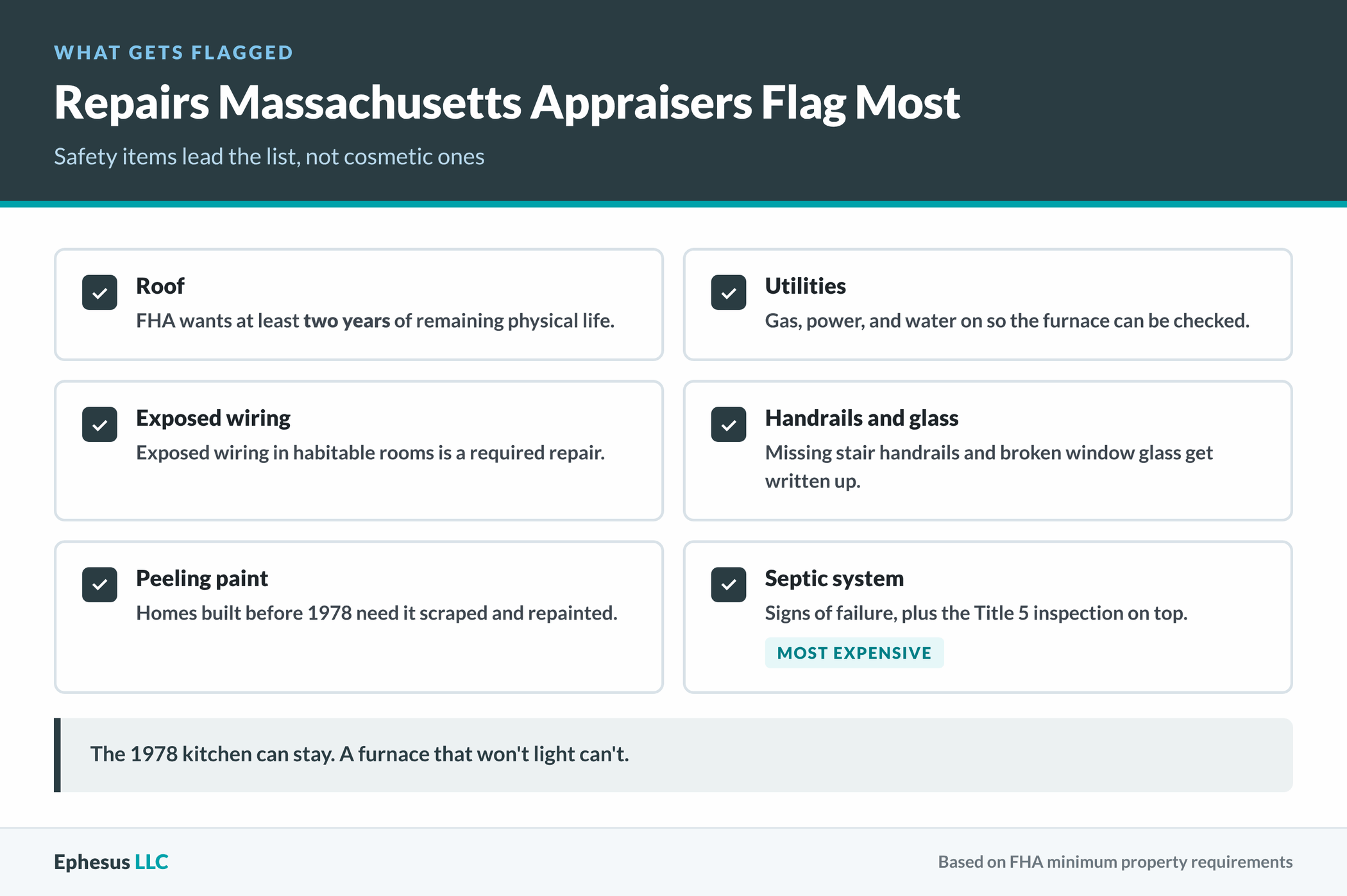
Septic systems deserve their own paragraph when you’re talking Massachusetts. Plenty of homes on the Cape, in Plymouth County, and across the western hilltowns run on septic. Appraisers look at septic systems for signs of failure or surface evidence of malfunction. Layer our Title 5 inspection requirement on top of that and a failed system becomes the most expensive line on any Massachusetts repair list.
Most sellers walk past a wobbly rail a thousand times without registering it.
Appraisal required repairs in Massachusetts skew heavily toward safety items precisely because the rules are written that way. The appraiser is judging whether the property is livable today, not whether it’s pretty. I’ve watched sellers in Medford spend a weekend painting a dining room nobody cared about, ignoring the real flag: a crumbling chimney crown.
Who Pays for Appraisal Required Repairs in Massachusetts?
A widow in Chelmsford once asked me why she had to pay for repairs on a house she was leaving, and I didn’t have a great answer for her beyond the arithmetic. Her buyer’s lender wanted the work, her buyer had nothing left after the down payment, and she had already committed her equity to a condo in New Hampshire.
The seller usually performs the repairs, and the appraiser re-inspects to confirm the work is finished. Not because it’s fair, but because the seller is the one with something to lose when a Massachusetts closing collapses.
Required repairs can be made by the seller, or the buyer can negotiate a different solution, and I’ve seen sales saved by buyers with cash who just handle the work themselves. Escrow holdbacks exist, though Massachusetts lenders approve them less often than sellers hope, and never for anything involving safety.
A cost shift worth considering: trading a price reduction for the repair obligation. Your buyer takes on the work after closing; you take less money. This only functions on conventional financing, since FHA appraisal required repairs must be completed before the loan funds, not after.
In most Massachusetts transactions the buyer covers the appraisal fee. Re-inspection after repairs usually gets billed to the buyer too, though that cost routinely gets pushed back onto sellers during negotiations.
My opinion, after a lot of these: sellers in Massachusetts agree to repair lists too quickly. Once you commit in writing to fixing five items, you own all five, including whatever the contractor finds behind the first one. So get a contractor to scope the work before you sign anything.
How Much Do Appraisal Required Repairs Cost in Massachusetts?
Wide range, and nobody can quote you a figure from a two-line appraisal comment. A handrail and a few electrical covers might be a Saturday and a hundred dollars at the Home Depot in Saugus. A roof on a Worcester colonial is a different universe.
Labor in Massachusetts is the multiplier. Contractors here charge Boston-metro rates even when they’re driving to Gardner, and the good ones have been booked solid for years. The quote you get in February and the quote you get in June for identical work won’t match.
This threshold matters on HUD-owned homes. There, a property needing more than $10,000 in repairs gets classified as uninsurable and becomes ineligible for FHA mortgage insurance. On a regular FHA sale, every flagged item has to be fixed no matter what it costs. Either way, a long list shrinks your buyer pool, which matters enormously in Massachusetts markets like Springfield and New Bedford where FHA financing carries a large share of transactions.
A home appraisal in Boston averages $382, with the usual range running from $354 to $454. Re-inspection fees are smaller than a full appraisal but they’re real money on a sale that’s already bleeding.
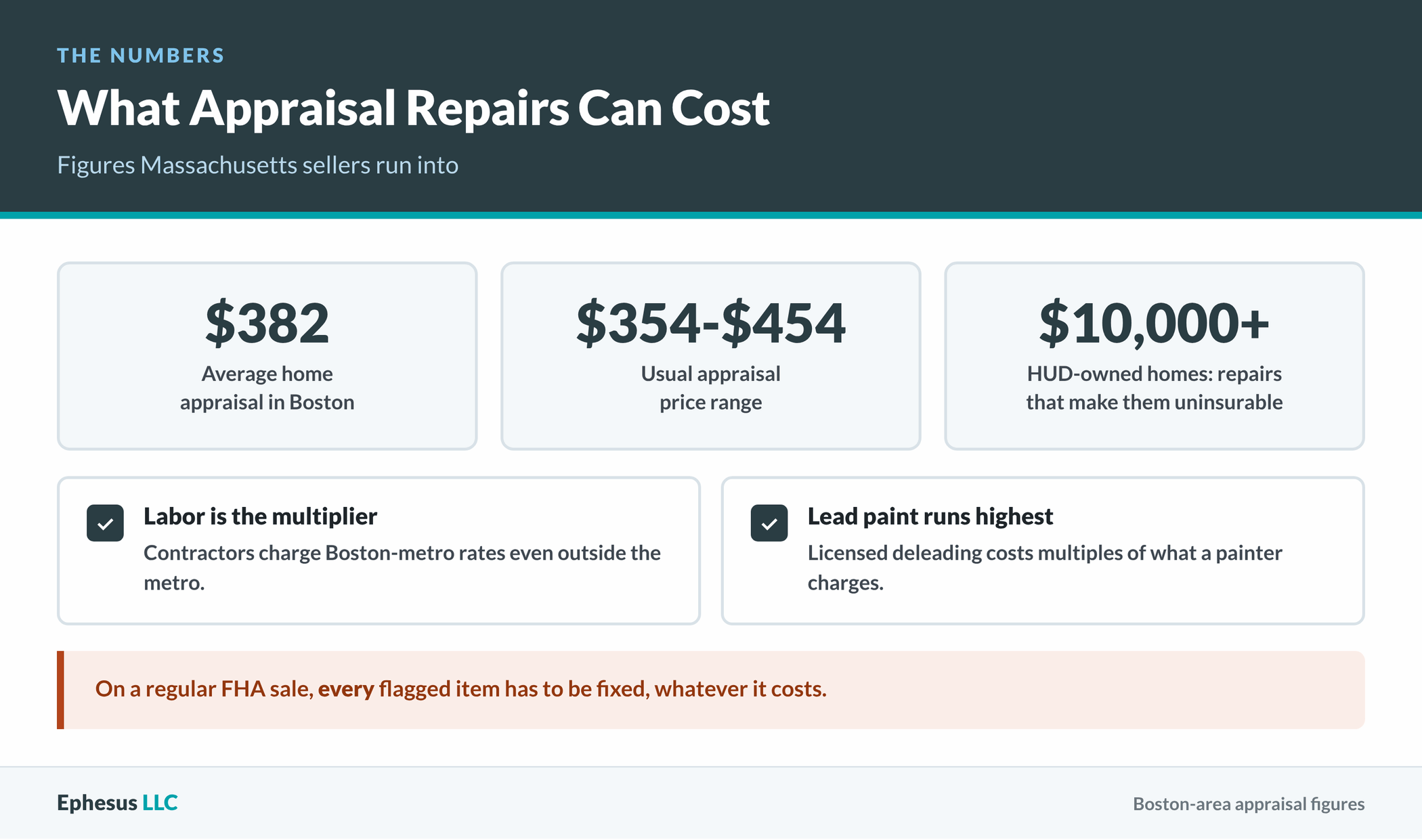
Lead paint work is where Massachusetts costs genuinely separate from the rest of the country. This is because our housing stock is old, our deleading rules are strict, and a licensed contractor costs multiples of what a painter charges. On a pre-1978 two-family in Everett, that one item can dwarf everything else on the list combined.
Opening one wall in a ninety-year-old Massachusetts house tends to reveal a second problem.
How Long Do Appraisal Required Repairs Take to Complete?
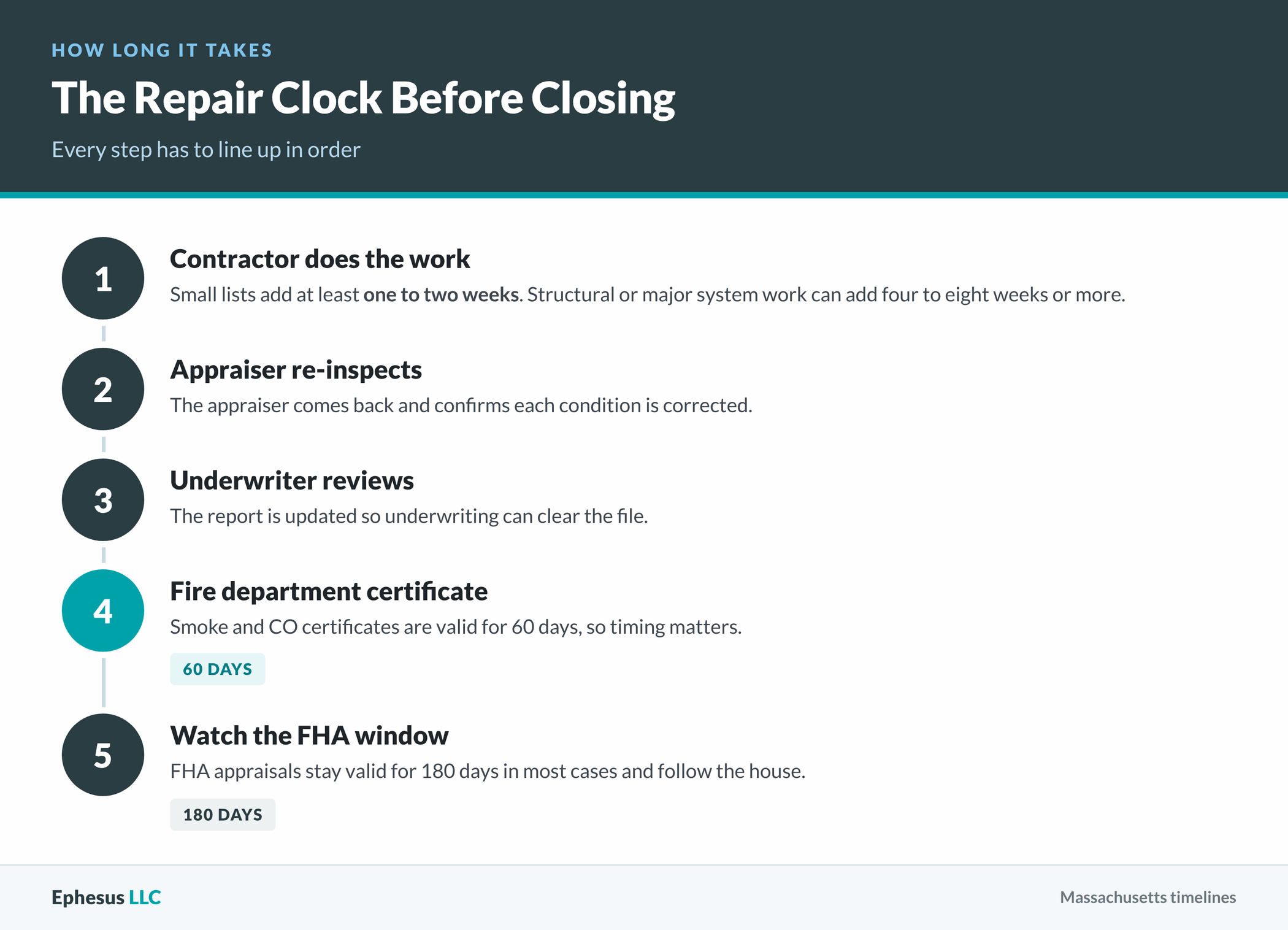
Sellers often hope the work wraps up in a weekend. It rarely works that way. Appraisal required repairs add a minimum of one to two weeks, and structural or major system work can tack on four to eight weeks or more. Your contractor’s calendar, the re-inspection appointment, and the underwriter’s review all have to line up in sequence.
Massachusetts weather removes months from the table. Roofing in January, exterior painting in a Pittsfield March, septic work on frozen ground: these aren’t scheduling problems, they’re physics problems. A sale that hits a repair list in late fall can sit until April.
Compare that to how fast our market normally moves. Over the three months ending October 2026, Middlesex County homes sold at a median of $787,000 and spent 24 days on the market, up from 21 days a year earlier. So a property under agreement briefly that then absorbs six weeks of repair work has been tied up longer in the fix-it phase than in the selling phase.
Electrical and plumbing work in most Massachusetts cities requires inspection by the local building department, and busy departments in places like Cambridge and Somerville don’t turn around same-week appointments in spring.
Then there’s the fire department certificate, which has its own clock. Certificates of compliance in Massachusetts are valid for 60 days. Inspections generally aren’t scheduled until a firm closing date is set. Push your closing too far chasing appraisal required repairs and a certificate issued early can expire before you get to the table.
How much slack does your buyer’s rate lock have left? That’s the question I’d be asking before agreeing to any repair timeline.
What Happens If You Skip Appraisal Required Repairs in Massachusetts?
Skipping the list doesn’t just delay your closing. The door closes harder than that. If a property fails the FHA appraisal or required inspections, the loan can’t move forward until the identified issues are resolved. No workaround, no exception, no sympathetic loan officer. Your buyer walks, probably with their deposit, depending on how the purchase and sale was written.
Worse, the report follows the house. An FHA case number attaches to the property, and the next FHA buyer who comes along in Taunton or Lynn inherits the same flagged conditions. FHA appraisals stay valid for 180 days in most cases. You can’t simply relist and hope for a kinder appraiser.
Statewide in September 2026, Massachusetts listings took a median of 45 days and 17.2% of them had a price cut. A house coming back on after a failed sale gets picked apart, and the discount buyers demand usually exceeds what the repairs would have cost.
Skipping appraisal required repairs makes sense when you sell to someone who isn’t borrowing. Cash buyers don’t order FHA appraisals, don’t need minimum property standards met, and don’t ask you to deliver a re-inspection. That’s a genuinely different path, not a lesser one.
The arithmetic decides it. Maybe the repair list runs past what your equity can absorb, or past what your patience can absorb. If so, selling as-is to a buyer like Ephesus LLC removes the entire category of problem from the table. No lender, no repair list, no appraiser returning to verify a handrail.
How to Sell a Massachusetts House with Appraisal Required Repairs
Figure out what the repairs would cost, figure out what the delay costs you in carrying expenses, then compare that total against what a direct buyer would pay. Two legitimate answers exist. On a sound house in Needham with a short list, fix it and list it on the open market, where the Massachusetts median sale price sat at $688,100 as of October 2026. On a house with a failed septic system and a tired roof, the math usually points elsewhere.
Massachusetts sellers sometimes hide a failed appraisal and it backfires every time, because the conditions are still there when the next appraiser walks through.
Order a pre-listing appraisal if you’re genuinely unsure. Spending a few hundred dollars to learn your real property value and your real exposure beats discovering both after you’ve signed a purchase and sale. Massachusetts appraisers are licensed through the Board of Registration of Real Estate Appraisers under the Division of Occupational Licensure, and verifying your appraiser’s credentials takes five minutes.
A Massachusetts house with known defects priced like a renovated one sits, and sitting is how sellers end up accepting less than the as-is offer they turned down in week one.
Carrying two mortgages for close to a year, a homeowner in Gloucester had been managing that when we talked. She’d bought her new place first, figured the old one would sell by Labor Day. Then two straight buyers walked after appraisal required repairs came back on the rear addition and the electrical panel. Her garage still had the moving boxes she’d never unpacked, stacked against a wall she’d meant to paint.
We closed on a timeline she picked, and she stopped writing the second check. Appraisal required repairs in Massachusetts aren’t a verdict on your house. They’re a fork in the road, and both directions lead somewhere.
Frequently Asked Questions
What Happens If an Appraisal Requires Repairs Before My Closing?
Your buyer’s lender won’t release the loan funds until the listed work is finished and verified. The appraiser comes back out, confirms the conditions have been corrected, and updates the report so underwriting can clear the file. If the work doesn’t get done, the financing dies and so does the sale, though you and your buyer can negotiate over who handles the repairs and who absorbs the cost.
How Much Does a House Appraisal Typically Cost in Massachusetts?
Expect a few hundred dollars for a standard single-family appraisal, with the figures in the cost section above reflecting what Boston-area homeowners pay. Larger properties, multifamily buildings, and unusual homes run higher because they take more time to analyze. Your buyer generally pays this fee up front as part of their loan application, and a return visit after repairs carries an additional smaller charge.
What Should I Avoid Saying to an Appraiser?
Skip anything about your financial pressure, your divorce, your deadline, or how badly you need the sale to go through. Don’t volunteer problems you haven’t been asked about, and don’t argue about value or try to steer which comparable sales get used. Do hand over documentation of real improvements with dates and permits, since that’s information a Massachusetts appraiser can actually use.
Can I Sell a House in Massachusetts Without Fixing What the Appraiser Flagged?
Yes, if your buyer isn’t using financing that demands the work. Cash buyers set their own standards and typically buy in current condition, so appraisal required repairs never enter the picture. You’ll trade some price for that certainty, which is a reasonable swap when the repair list is long or the timing is bad.
Does a Failed Appraisal Mean My Massachusetts House Is Worthless?
Not remotely. A flagged report means specific conditions don’t meet one particular loan program’s standards, and those standards are stricter than what most Massachusetts buyers personally care about. Houses with repair flags sell constantly in this state, just to a different slice of the market.
If you’re sitting with a repair list and no clear way forward, we’re glad to talk it through, including the option where we’re not involved at all. Reach out to Ephesus LLC whenever you’re ready. No pressure, no obligation, and no hard feelings if you decide to fix the house and list it instead.
Boston Area Sellers With an Appraisal Repair List
A repair list doesn’t erase your equity. Zillow put the typical Massachusetts home value at $655,219 through September 2026, up 2.3% from a year earlier. You don’t have to spend that equity on contractors before you sell. We buy houses in their current condition from homeowners around Boston and across the state.
Get a Cash Offer Without the Repair List
If an appraiser flagged your house and you’d rather skip the repairs, contact Ephesus LLC and tell us about the property. We’ll look at it as it stands today, with no re-inspection and no lender list. Fill out the short form below to get started.
Helpful Massachusetts Blog Articles