
A signature on a deed carries enormous weight in Massachusetts, so most people figure that weight protects them automatically. I’ve spent years buying houses across the Commonwealth, and the question about an ex partner selling a shared home comes up more than almost any other. Four letters typed onto your deed years ago determine the answer, back when nobody imagined a split.
Can My Ex Partner Sell Our House Without My Approval in Massachusetts?
Most owners assume two names on a deed means nobody can sell alone. That logic holds right up until you read what kind of co-ownership those two names created, because Massachusetts recognizes several, and they behave very differently under pressure.
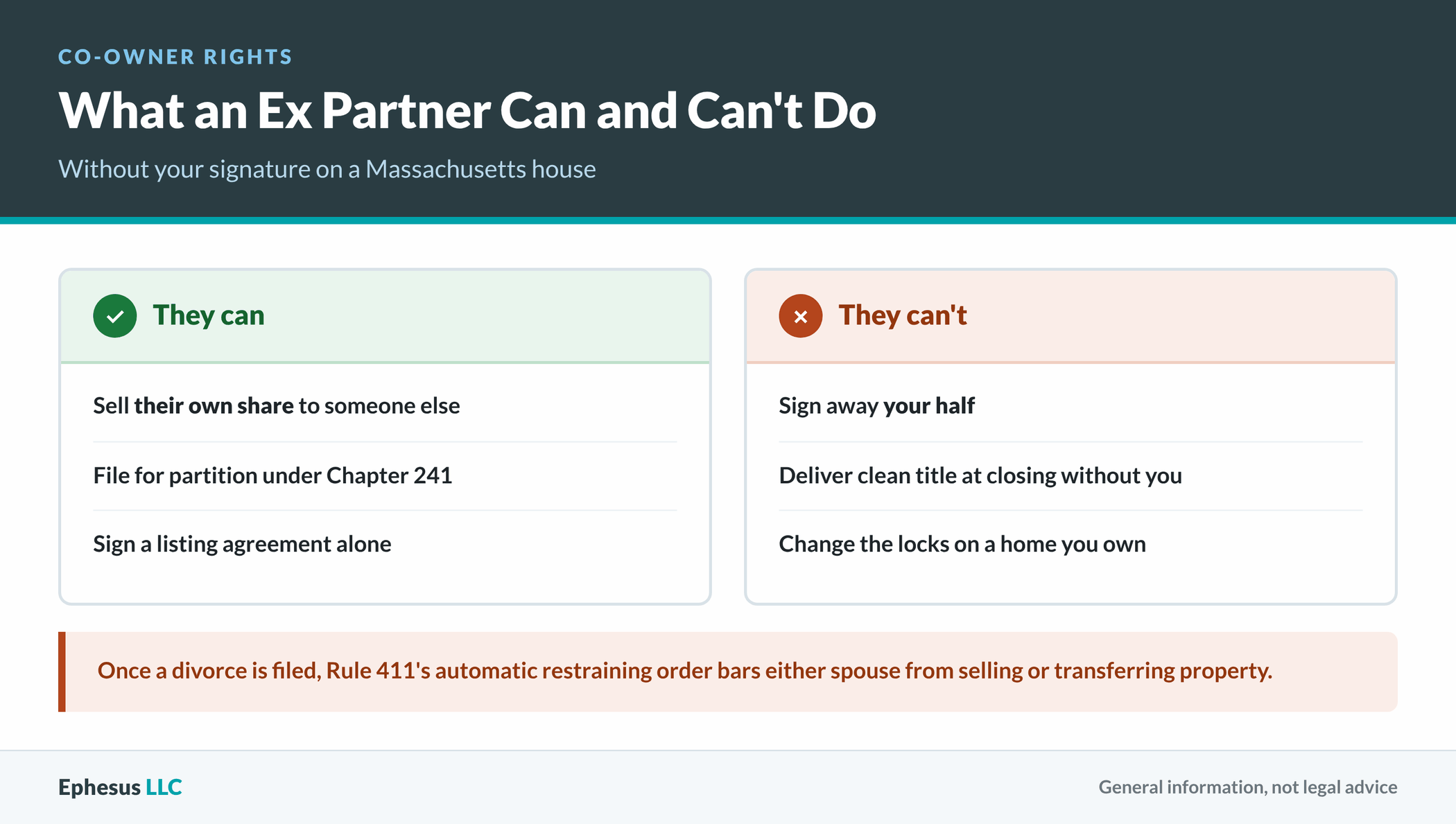
Your ex partner cannot sign away your half, because nobody can convey an interest they don’t own. A former partner holding title as a joint tenant or a tenant in common can sell their share to a stranger without asking you first. Your new co-owner is that stranger stepping into their shoes.
Worse, a co-owner who wants out has a court remedy that doesn’t need your blessing at all. Partition in Massachusetts runs through Chapter 241 of the General Laws. Any co-owner holding as a tenant in common or a joint tenant has an absolute right to file, even when the others object. So the real answer to whether they can force a Massachusetts sale is yes, eventually, through the courthouse.
Every week before an auction date counts. A family in Brockton called me early last year, three months behind on payments with an auction date already stamped on the foreclosure notice taped to their storm door. They’d been fighting over the house for eight months; the snowblower in the garage had never been unboxed because neither one wanted to be the person who stayed.
They needed a closing date before the auctioneer got one.
Moving gives you some runway thanks to Massachusetts housing numbers. Statewide listings took a median of 45 days in September 2026, and about 17 percent of them had taken a price cut. This is time you may not have when a mortgage is in default and they have already lawyered up.
Joint Ownership and Title Rules for Ex Partners in Massachusetts
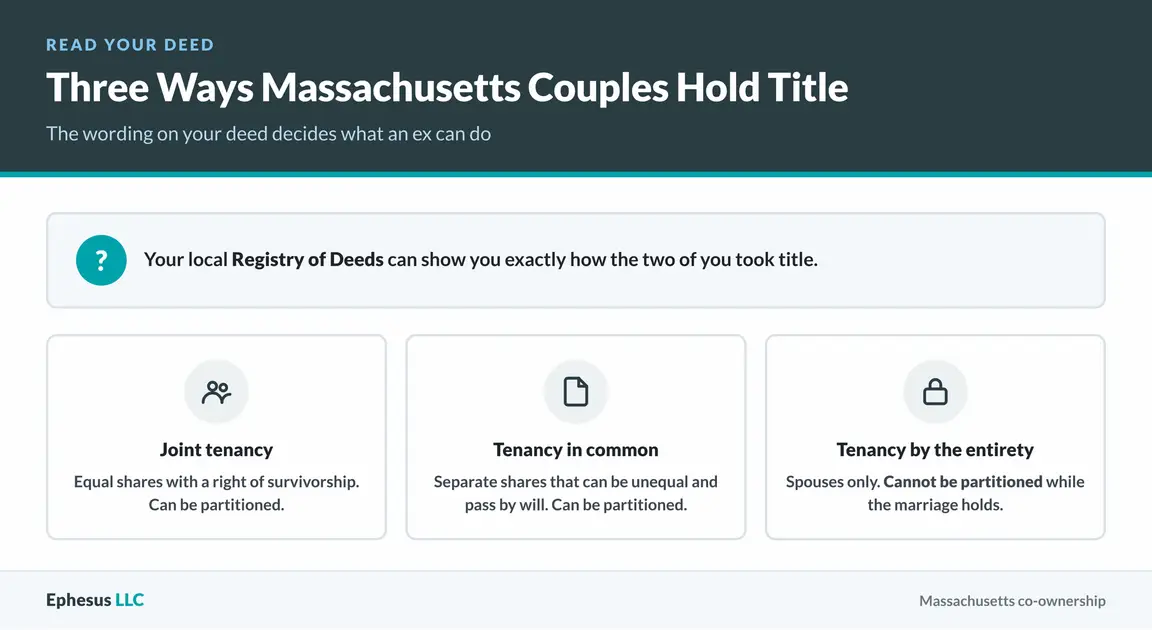
Joint tenancy and tenancy in common aren’t interchangeable, and in a breakup the difference decides who can do what.
Joint tenants in Massachusetts hold equal shares with a right of survivorship attached. Should one die, the other absorbs the whole property automatically, so no probate court gets involved. Tenants in common hold separate, transferable shares that can be unequal; sixty percent to one person and forty to the other is perfectly ordinary. Those shares pass by will or inheritance to an heir rather than to the surviving co-owner.
Tenancy by the entirety is reserved for spouses, and it carries protection the other forms lack, which means married couples get a third option. A property owned by a husband and wife as tenants by the entirety cannot be partitioned. The shield holds while the marriage holds.
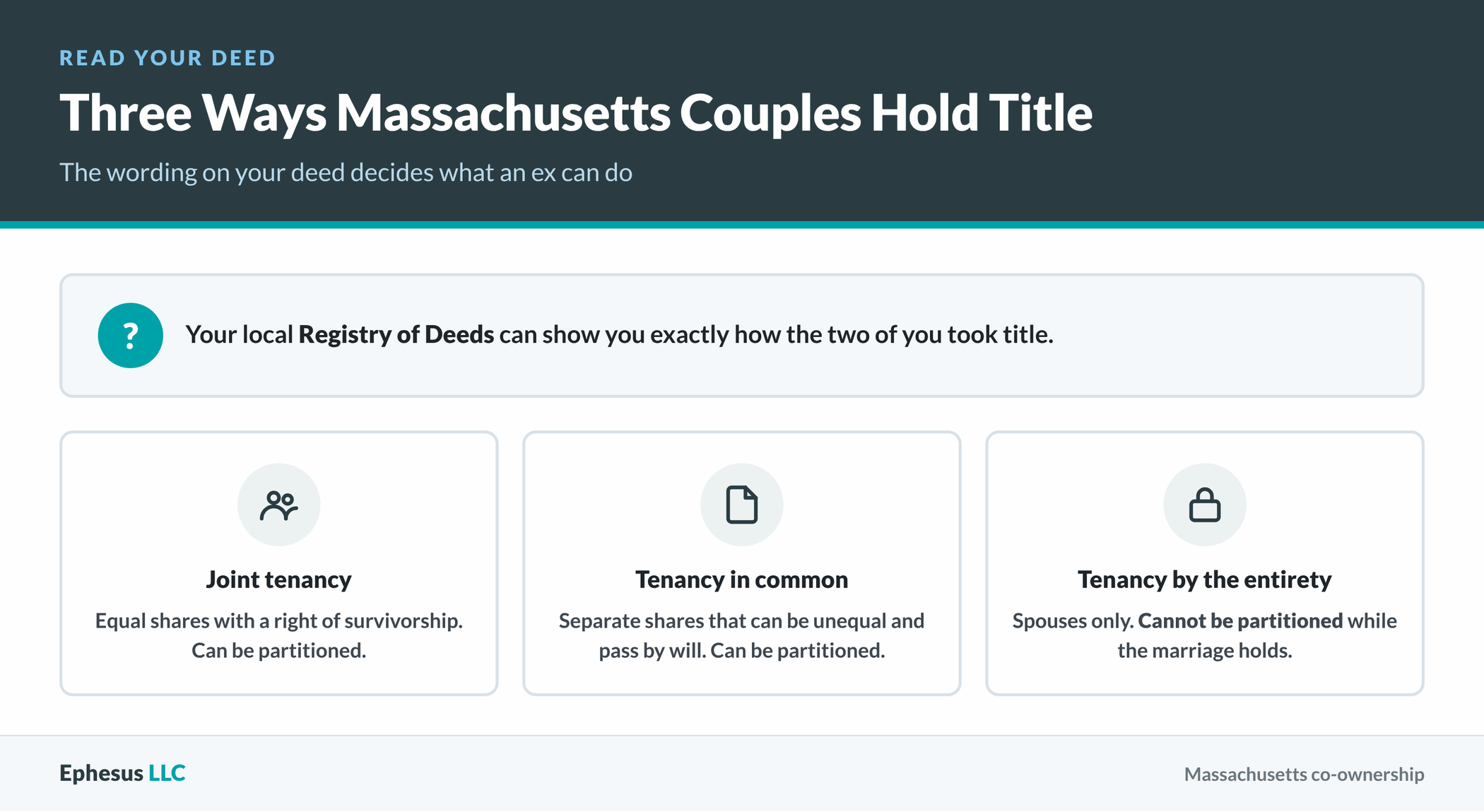
Someone you never married almost certainly shares title with you as a joint tenant or tenant in common, so the Chapter 241 door stands open. Unmarried partners who separate and can’t agree on a sale or a buyout are among the most common filers of these partition cases. Your local Registry of Deeds keeps the recorded instrument, and the clerk there can point you to the exact page showing how the two of you took title. Reading that one line before calling an attorney saves you a consultation fee and a lot of guessing.
Being on the mortgage doesn’t put you on the title. Whose name sits on the loan and whose name sits on the deed are two separate questions, and they can be on one without being on the other.
Does My Ex Partner Need My Approval to List the House?
A seller in Chicopee reached out after spotting her own home on a listing site, photographed on a Tuesday while she was at work. Her former partner had signed a listing agreement alone and told the agent the other owner was “fine with it.”
They can absolutely sign a listing agreement. Agents in Massachusetts do ask for all owners’ signatures, but plenty of listings go live with one, especially when the agent takes a seller’s word about the co-owner’s position.
What your ex partner cannot do is deliver clean title at the closing table without you. Massachusetts closings run through attorneys, and a title examiner reviewing the Registry chain will spot a missing owner immediately. The buyer’s lender won’t fund. The sale collapses, usually after everyone has spent money on inspections and appraisals.
A property that goes under agreement and then falls apart carries a stink, so buyers who track the Massachusetts market notice relisted homes and start hunting for the defect. Middlesex County saw a median sale price around $787,000 over the three months ending October 2026, with homes averaging 24 days on market. A failed sale adds weeks to that clock and typically shaves money off the next offer.
If a divorce complaint has been filed, the ground shifts hard. Rule 411’s automatic restraining order binds the person who files the moment the case is filed, and binds the other spouse upon service of the divorce complaint. Its language forbids either party from selling, transferring, or encumbering property while the case is pending. The rule bars either spouse from selling, transferring, encumbering, concealing, assigning, removing, or disposing of real or personal property. You can read the rule’s terms discussed at Mavrides Law.
Massachusetts Homestead Rights for Separating Partners
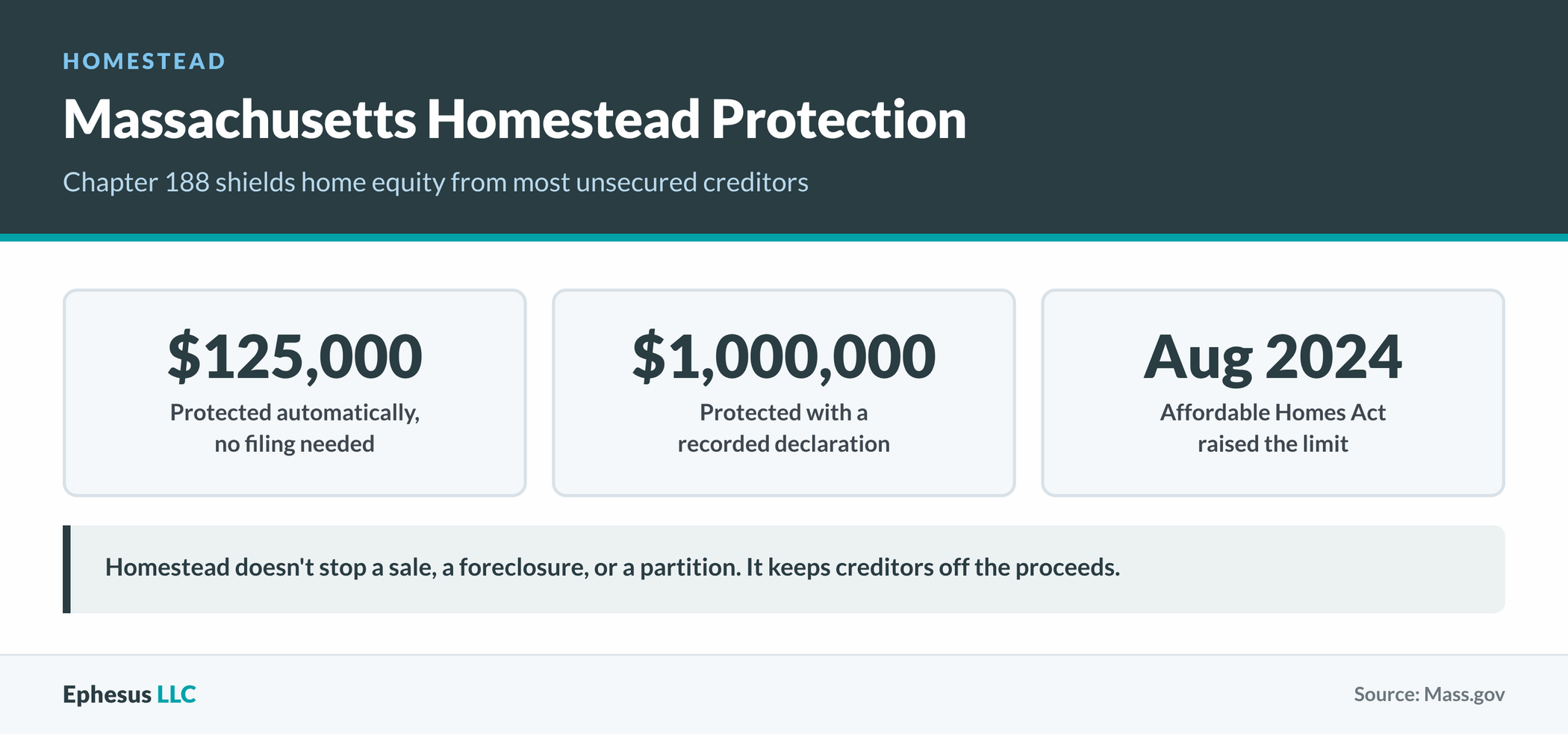
Homestead protection in Massachusetts shields home equity from most unsecured creditors, and it matters enormously during a breakup when old credit card debt and medical bills surface. Chapter 188 automatically protects up to $125,000 in home equity without any filing, and owners who record a declaration can get up to $1,000,000, per the Mass.gov homestead page. That higher figure came from the Affordable Homes Act signed in August 2024, which raised the declared exemption from its prior level.
Record the declaration. It costs very little at the Registry and it protects the equity the two of you are about to divide.
Homestead doesn’t stop a sale, though, and separating owners confuse this constantly. It doesn’t block a mortgage foreclosure, it doesn’t block a partition, and it doesn’t give you veto power over someone who wants out. What it does is keep outside creditors from eating the proceeds before you and they split them.
A non-owner spouse living in the home has the benefit of the homestead until it’s terminated in writing, which is one reason signing documents your ex slides across the table deserves real caution. Terminating a homestead is one of the quieter ways people in Massachusetts give up protection without realizing what the signature line did.
Whether you’re married shapes homestead rights, and in Massachusetts it also shapes how a judge later views each side’s contribution to the mortgage, taxes, and upkeep.
Marital Property Vs. Separate Property When an Ex Partner Sells
A married couple’s house doesn’t automatically split down the middle, and Massachusetts is blunter about this than many states are. The Commonwealth follows equitable distribution, meaning a Probate and Family Court judge divides property fairly rather than mechanically down the middle. Massachusetts property division is equitable distribution, not necessarily 50/50.
Inheritance, premarital property, gifts from family: all of it can land in the marital pot in Massachusetts, because judges weigh contributions, length of the marriage, and the needs of each spouse. An ex partner who never appeared on the deed may still walk away with a real share of your Massachusetts house.
No marriage means no equitable distribution, so the deed governs almost everything. If your ex partner paid two-thirds of every mortgage payment but holds a fifty percent tenancy in common interest, that extra contribution doesn’t automatically convert into extra ownership. It becomes an argument about credits, raised inside a partition case.
The commissioner appointed in a partition often recommends whether a co-owner should receive more or less equity than their straight percentage share. Sellers who can hand an attorney a clean folder of bank statements and texts about who paid the roof bill do far better than the ones relying on memory.
For a married homeowner in Massachusetts, the practical upshot is simple: your divorce agreement, not the deed, usually determines who gets what from the sale. For an unmarried one, the deed is king and your ex partner’s leverage comes from Chapter 241.
What Happens If My Ex Partner Sells Without My Consent?
Selling costs in a partition run higher and the final price typically comes in lower than a normal market sale. Everyone fighting for a bigger slice ends up with a smaller pie.
Suppose your ex forges your signature or sells a share without telling you. A forged signature conveys nothing, and title insurers in Massachusetts treat these claims seriously once they surface.
More common than forgery: your ex partner sells their own undivided interest legitimately. Now you co-own a Massachusetts property with an investor who bought at a discount and has no emotional attachment whatsoever. I’ve seen this play out with investor buyers more than once, and that buyer files for partition within months, because that’s the business model.
Then there’s the divorce scenario. Judges weigh violations of the automatic restraining order when they decide how to divide marital property, so an ex partner who moves a Massachusetts property mid-case usually pays for it in the final judgment. Massachusetts judges can award concealed property plus attorney’s fees to the other spouse, and can reopen a settlement years later.
If you and your ex partner can agree on a sale and a split, even a lopsided one, you keep money that the courthouse would otherwise absorb. Owners who want certainty on a date sometimes bring in a direct buyer like Ephesus LLC, since a cash closing removes the lender contingency that kills these sales.
Legal Steps If an Ex Partner Sells Property Without Approval
Sitting at a kitchen table in Massachusetts with a seller in this spot, the first thing I say is: go get your deed today, not next week.
You’ll learn in an afternoon whether anything has been recorded against your interest.
File a lis pendens if litigation is underway. That notice warns the world your Massachusetts property is in dispute, and it stops a quiet transfer from your ex partner to a buyer who claims ignorance.
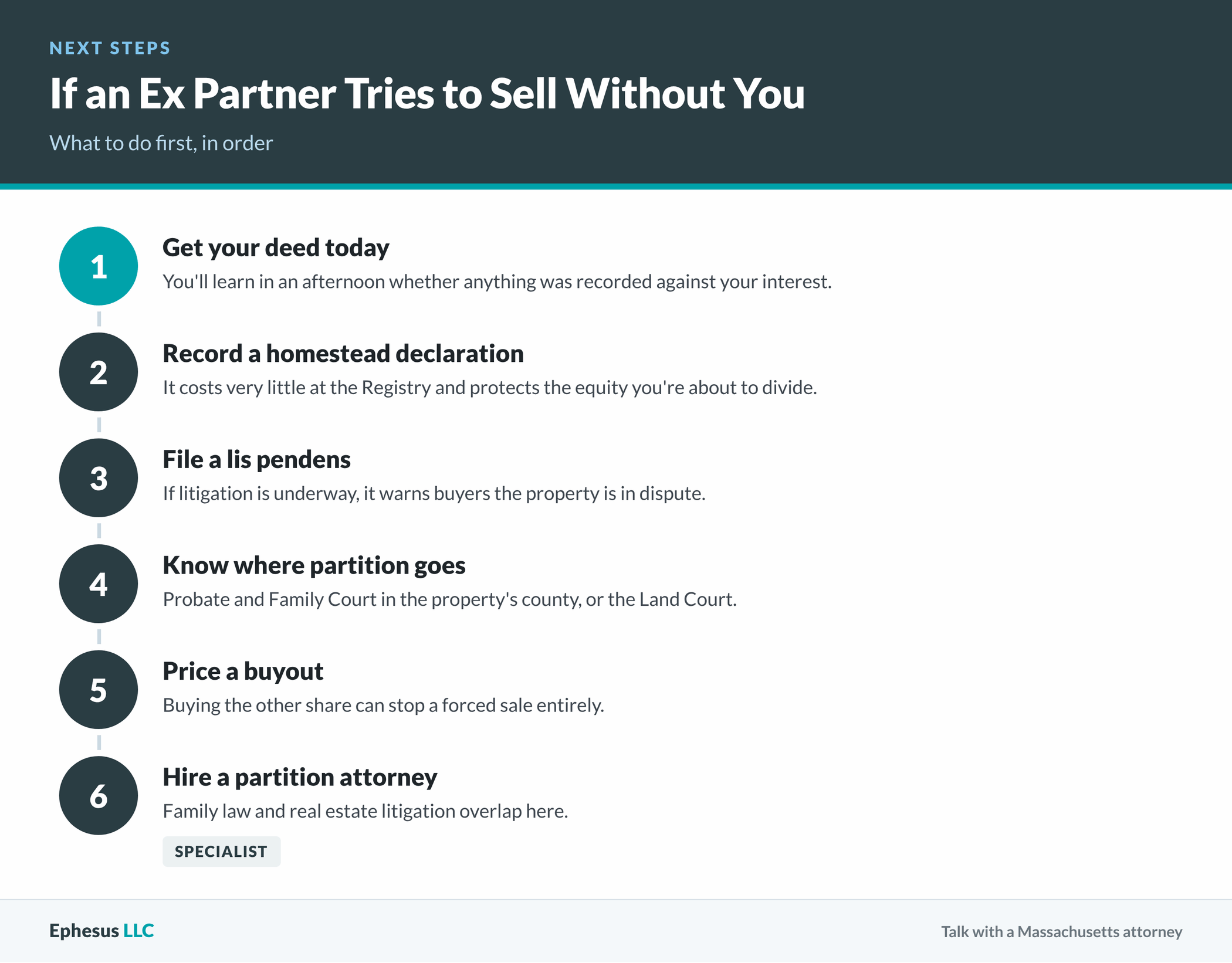
Where does a partition case go? A Petition to Partition can be filed in the Probate and Family Court for the county where the property sits, or in the Massachusetts Land Court. From there, the court evaluates how to divide the property. If it can’t be advantageously divided, a forced sale is ordered, and the court itself must make that assessment under the statute before ordering partition either in kind or by sale. Details on the filing process appear at Frank Grimaldi Law.
An owner who wants to keep the property can buy out the other person’s share and prevent the sale entirely. Refinancing in Massachusetts at current rates makes that math tough for some owners, but it’s worth pricing before you commit to a court fight with your ex partner.
Hire a Massachusetts attorney who handles partition specifically. Family law and real estate litigation overlap here, and the lawyer who handled your closing may not be the right one for a dispute with a former partner over a Massachusetts deed.
Still Need Legal Help with Your Ex Partner Property Dispute?
Most of these fights are really about money disguised as principle, and the Massachusetts court system charges a steep fee to referee them.
Talk to a Massachusetts attorney early, even for one hour. The Massachusetts Bar Association runs a lawyer referral service, and legal aid offices around the Commonwealth handle housing matters for qualifying households. An hour of real advice about your specific deed beats weeks of reading general articles about what an ex partner can and can’t do.
Equity has a way of shrinking as two people argue; carrying costs keep running, the roof keeps aging, and a Massachusetts winter finds every weak spot in a property nobody’s maintaining.
An owner out in Pittsfield reached out after watching two separate agent listings expire with not a single offer, nine months of showings and open houses gone. Her ex partner had moved to Connecticut and stopped responding to the agent’s emails altogether, so every appointment request died in her inbox. The finished basement she’d spent a summer painting never got seen by anyone serious.
Selling the house outright, as-is, sometimes ends an ex partner dispute faster than any motion will. Both sides get cash, both sides get a date, and the argument over who gets the kitchen table stops mattering. We’ve bought Massachusetts houses where the two owners never once stood in the same room, and it always struck me how smoothly those sales closed; attorneys handled the paperwork and both parties signed separately.
If you’re weighing that route, Ephesus LLC buys Massachusetts properties in whatever condition they’re in, including ones tangled up in co-ownership disputes.
Frequently Asked Questions
Can My Ex Partner Force Me Out of the Massachusetts House We Both Own?
Not on their own. Each co-owner in Massachusetts holds an equal right to occupy the whole property, so your ex partner can’t change the locks or evict you from a home you own. What your ex partner can do is ask a court to end the shared ownership, and if a judge orders a sale, occupancy ends when the property transfers.
What If My Name Is on the Mortgage but Not the Deed in Massachusetts?
That’s a rough spot, and it happens more than you’d think with couples in Massachusetts who bought during a refinance. You carry the debt without holding title, meaning your ex partner controls the property while your credit absorbs any missed payments. Talk to a Massachusetts attorney about a constructive trust claim or an equitable interest argument, and get your name off that loan as part of any settlement.
How Long Does a Partition Case Take in Massachusetts?
Longer than almost anyone wants. A straightforward case with cooperative parties might resolve in several months; a contested one with disputed credits and an uncooperative ex partner can run well past a year. The commissioner’s work, the appraisal, and the court’s calendar all add time, and legal fees come out of the sale proceeds before either party sees a dollar.
Does a Prenuptial Agreement Change What My Ex Partner Can Do with Our Massachusetts Home?
It can, quite a lot. A properly drafted and legally binding prenuptial or postnuptial agreement in Massachusetts can spell out exactly who keeps the house and on what terms. Courts generally enforce those agreements when both parties had independent counsel and full disclosure. Pull the document out and read the property section before you assume anything about your ex partner’s rights.
Can I Sell My Share of the House to Someone Else in Massachusetts?
If you hold title as a tenant in common or a joint tenant, yes, your interest is yours to convey. Few buyers want a partial interest in a house occupied by a stranger’s ex partner, so the market for those shares is thin and the pricing is poor. Selling the whole property jointly almost always puts more money in both pockets.
Does the Right of Survivorship Still Apply After We Break Up?
Yes, until the deed changes or the joint tenancy is severed. A joint tenancy survives a breakup and even a divorce filing in Massachusetts unless somebody takes action to end it. Plenty of people in Massachusetts assume the relationship’s end dissolved that arrangement, then learn otherwise at the worst possible moment.
If you’re staring down a dispute with an ex partner over a Massachusetts house, we’re glad to walk through the numbers with you and talk through what a sale might look like. No pressure, no obligation, and no hard feelings if you decide the courthouse route makes more sense for your situation.
Massachusetts Co-Owners Who Want a Clean Exit
Massachusetts homes still carry solid equity, which is why these disputes get heated. Zillow put the typical Massachusetts home value at $655,219 through September 2026. Dividing that equity is easier with one buyer, one date, and one check. We buy houses from co-owners around Boston and across the Commonwealth, including homes caught in a split.
Talk Through Your Options With Us
If you’re stuck on a shared house after a breakup, contact Ephesus LLC for a private conversation. We’ll lay out what a sale could look like, with no pressure and no obligation. Fill out the form below whenever you’re ready.
Helpful Massachusetts Blog Articles